Pleck - Round Oak
The following photos show scenes on the section of line between Pleck Jct and Round Oak. The line closed in March 1993, and
the photos are arranged in a "before and after" format. Most of the "before" photos were taken around 1988-1993, in the last few
years before closure. The first set of "after" shots were taken circa 2004-2006, around a decade after closure. In many cases it turned
out that there was a limited window of opportunity in which to take these "after closure" shots. It's often the case that vegetation
eventually takes over to such an extent that a meaningful picture is no longer available. A shot with nothing in view other than
scrub or trees which shows no sign of railway infrastructure, or even the alignment, is of little value.
However in 2017 some vegetation clearance and track removal work commenced at various locations south of Wednesbury. This was done
to facilitate surveying work in preparation for the eventual use of the trackbed for trams. This clearance work opened up a number
of spots for photographs once more, although it also involved the removal of the track, leaving only the alignment itself, plus
bridges and tunnels.
The locations are arranged in geographical sequence, starting at the northern end of the line and working south.
Apologies in advance if you find the later pictures depressing.
Wood Green (Wednesbury)
-
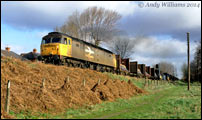
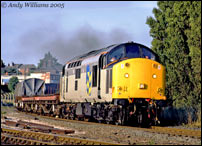
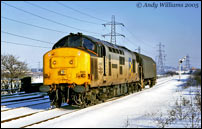
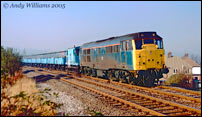
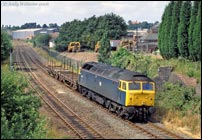
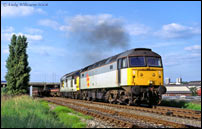 August 1992: 47051 storms away from Bescot Curve Jct with a 6Z04 empty steel train at 17:58 on Thursday 6th August 1992.
Behind the Duff in this Cardiff-bound special is 37274, which had brought the train into Bescot earlier that afternoon. Bescot Curve Jct is
just on the far side of the M6 motorway, and the locos have just come off the viaduct at Wood Green. Just visible to the right is the Drop
Forgings, probably closed by this time.
August 1992: 47051 storms away from Bescot Curve Jct with a 6Z04 empty steel train at 17:58 on Thursday 6th August 1992.
Behind the Duff in this Cardiff-bound special is 37274, which had brought the train into Bescot earlier that afternoon. Bescot Curve Jct is
just on the far side of the M6 motorway, and the locos have just come off the viaduct at Wood Green. Just visible to the right is the Drop
Forgings, probably closed by this time.
-
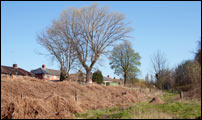
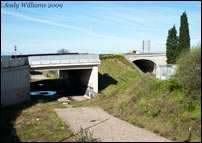
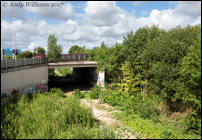
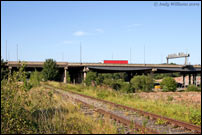 August 2004: The (nearer) down line is completely hidden under vegetation, but the up line remains visible. The Drop
Forgings have been demolished, and all that remains is rubble. In 2016 a large Lidl Distribution Centre was built on this site.
August 2004: The (nearer) down line is completely hidden under vegetation, but the up line remains visible. The Drop
Forgings have been demolished, and all that remains is rubble. In 2016 a large Lidl Distribution Centre was built on this site.
Ridding Lane (Wednesbury), looking north
-
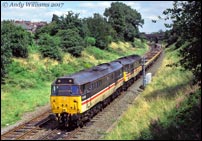 July 1992: 31422 and 31407 approach Wednesbury at 13:09 on Tuesday 28th July 1992. This was a T90 Worcester - Wednesbury
trip that had gone to Bescot, apparently in error, and is seen here returning to Wednesbury.
July 1992: 31422 and 31407 approach Wednesbury at 13:09 on Tuesday 28th July 1992. This was a T90 Worcester - Wednesbury
trip that had gone to Bescot, apparently in error, and is seen here returning to Wednesbury.
-
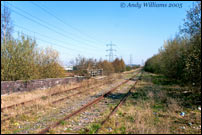
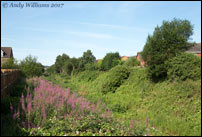
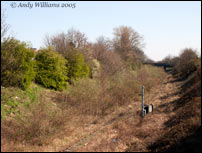 April 2004: The down line was noticeably more overgrown than the up line at this time. The signal post here was redundant
before the line closed, Wednesbury's up home colour-light having been re-positioned about 300 yards further south, just short of the Lower
High St road bridge.
April 2004: The down line was noticeably more overgrown than the up line at this time. The signal post here was redundant
before the line closed, Wednesbury's up home colour-light having been re-positioned about 300 yards further south, just short of the Lower
High St road bridge.
-
July 2017: No shot available, the trackbed is covered in scrub and mature trees, as high or higher than the road bridge.
Ridding Lane (Wednesbury), looking south
-
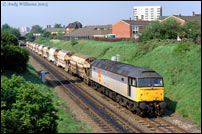 May 1989: 47205 trundles through Wednesbury with the 6M72 Gloucester - Cliffe Vale china-clay at 09:35 on Monday 22nd May
1989. The china clay emanates from Cornwall and the midweek train started at St Blazey (Par). However the Friday train recessed at Gloucester
in the early hours of Saturday, and re-started from there on Monday morning. Sadly this long-standing traffic flow is not what it was. Daily
trains of ten or eleven wagons no longer run, by the 2010s it was down to a once-weekly service, albeit usually formed of about eighteen
wagons.
May 1989: 47205 trundles through Wednesbury with the 6M72 Gloucester - Cliffe Vale china-clay at 09:35 on Monday 22nd May
1989. The china clay emanates from Cornwall and the midweek train started at St Blazey (Par). However the Friday train recessed at Gloucester
in the early hours of Saturday, and re-started from there on Monday morning. Sadly this long-standing traffic flow is not what it was. Daily
trains of ten or eleven wagons no longer run, by the 2010s it was down to a once-weekly service, albeit usually formed of about eighteen
wagons.
-
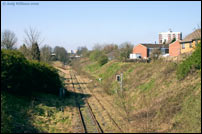 April 2004: This later shot is from a narrower angle due to trees on the left. The posts for two of Wednesbury's colour light
signals are still visible. On the left is the up home (WY4), re-positioned to this location just short of Lower High St road bridge. It was
three-aspect, with a subsidiary calling-on signal and two stencil indicators below. In earlier times it was positioned in rear of the Ridding
Lane bridge, from which this photo was taken. The old post, visible in this shot, survived until the
line was closed and beyond. Nearer the camera is the three-aspect down starter (WY47).
April 2004: This later shot is from a narrower angle due to trees on the left. The posts for two of Wednesbury's colour light
signals are still visible. On the left is the up home (WY4), re-positioned to this location just short of Lower High St road bridge. It was
three-aspect, with a subsidiary calling-on signal and two stencil indicators below. In earlier times it was positioned in rear of the Ridding
Lane bridge, from which this photo was taken. The old post, visible in this shot, survived until the
line was closed and beyond. Nearer the camera is the three-aspect down starter (WY47).
-
July 2017: No shot available, the trackbed is covered in scrub and mature trees, as high or higher than the road bridge.
Golds Hill
-
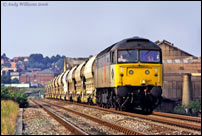 July 1990: 47312 is seen on the climb from Wednesbury to Great Bridge with the 6V70 Cliffe Vale - St Blazey china-clay empties.
This photo was taken at 18:21 on Friday 13th July 1990, and a long lens was used to crop out the electricity pylons which sit either side of the
line here.
July 1990: 47312 is seen on the climb from Wednesbury to Great Bridge with the 6V70 Cliffe Vale - St Blazey china-clay empties.
This photo was taken at 18:21 on Friday 13th July 1990, and a long lens was used to crop out the electricity pylons which sit either side of the
line here.
-
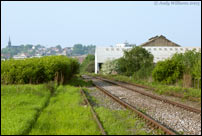 May 2004: The view from Golds Hill foot crossing hadn't changed much by this stage, apart from the additional vegetation.
The church on the left is St Bartholomew's, Wednesbury. Cashmore's scrapyard was on the other side of the running lines, just behind the camera.
Access was provided by a trailing connection from the yard into the down line (i.e. facing Wednesbury). Where this connection crossed
the up line there was a single-slip which allowed access into the scrapyard from the Wednesbury direction. This pointwork was still
extant, as was the gate to the scrapyard - although the scrapyard itself was long gone by this date.
May 2004: The view from Golds Hill foot crossing hadn't changed much by this stage, apart from the additional vegetation.
The church on the left is St Bartholomew's, Wednesbury. Cashmore's scrapyard was on the other side of the running lines, just behind the camera.
Access was provided by a trailing connection from the yard into the down line (i.e. facing Wednesbury). Where this connection crossed
the up line there was a single-slip which allowed access into the scrapyard from the Wednesbury direction. This pointwork was still
extant, as was the gate to the scrapyard - although the scrapyard itself was long gone by this date.
-
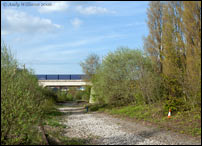
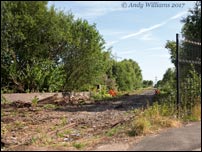
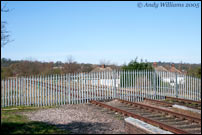
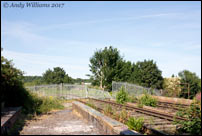
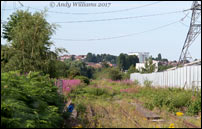 July 2017: This is a slightly wider view than earlier ones, so the electricity pylons and cables can be seen here. Not much
has changed on the trackbed; the track was still in situ for about 700 yards down the hill, and the vegetation only just covered the rails.
The bridge in the foreground carries the railway over the Tame Valley canal. The real changes here are to the sides of the railway, where tree
growth on the left hides most of Wednesbury town centre, including the church spires. On the right the old factories have been replaced by
newer ones, and a great big fence erected.
July 2017: This is a slightly wider view than earlier ones, so the electricity pylons and cables can be seen here. Not much
has changed on the trackbed; the track was still in situ for about 700 yards down the hill, and the vegetation only just covered the rails.
The bridge in the foreground carries the railway over the Tame Valley canal. The real changes here are to the sides of the railway, where tree
growth on the left hides most of Wednesbury town centre, including the church spires. On the right the old factories have been replaced by
newer ones, and a great big fence erected.
Dudley Port
-
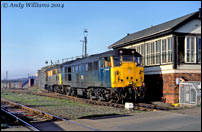
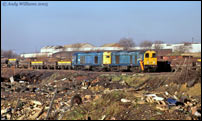
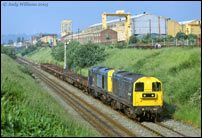
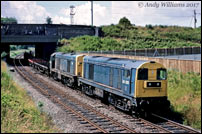 July 1988: 20225 and 20203 pass under the Stour Valley line at Dudley Port with 6E29, the Brierley Hill - Scunthorpe steel empties.
This shot was taken at 12:02 on Tuesday 5th July 1988.
July 1988: 20225 and 20203 pass under the Stour Valley line at Dudley Port with 6E29, the Brierley Hill - Scunthorpe steel empties.
This shot was taken at 12:02 on Tuesday 5th July 1988.
-
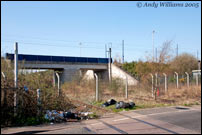
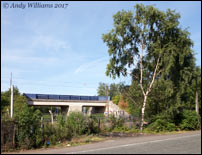
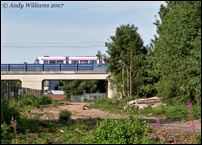
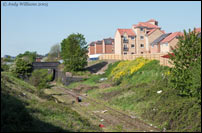
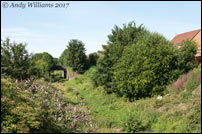
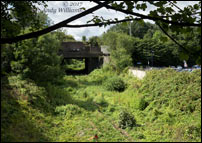 July 2017: The track was still in situ around Dudley Port, albeit under a carpet of greenery. By this stage the land to the
right of the South Staffs line was in use as the station car park, but like some others in Centro-land it wasn't big enough to cater for the
demand.
July 2017: The track was still in situ around Dudley Port, albeit under a carpet of greenery. By this stage the land to the
right of the South Staffs line was in use as the station car park, but like some others in Centro-land it wasn't big enough to cater for the
demand.
Pedmore Road (Dudley), looking north
-
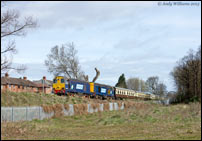
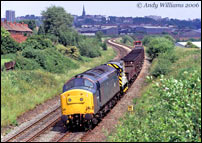 June 1989: 37207 drifts downhill from Dudley with 9V01, the Bescot - Gloucester departmental service. This shot was taken on
Tuesday 13th June 1989, and the shunter behind the train engine is 08646 returning from Crewe Works to Landore. Just above the brakevan is Parkhead
Viaduct, and the distant spire belongs to St Thomas in Dudley ("Top Church" to the locals, it's at the top of the High St). Thanks to Dave
Gommersall for providing the number of the shunting loco and the date of this shot.
June 1989: 37207 drifts downhill from Dudley with 9V01, the Bescot - Gloucester departmental service. This shot was taken on
Tuesday 13th June 1989, and the shunter behind the train engine is 08646 returning from Crewe Works to Landore. Just above the brakevan is Parkhead
Viaduct, and the distant spire belongs to St Thomas in Dudley ("Top Church" to the locals, it's at the top of the High St). Thanks to Dave
Gommersall for providing the number of the shunting loco and the date of this shot.
-
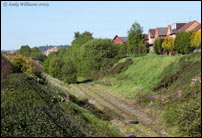
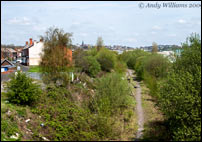 April 2004: This shot was taken from a position slightly to the left of the original, and with a widerlens, due to vegetation
encroachment. Most of the track is missing at this spot, and at the time the vegetation was as bad as anywhere on the line. However it was still
possible to see Dudley town centre.
April 2004: This shot was taken from a position slightly to the left of the original, and with a widerlens, due to vegetation
encroachment. Most of the track is missing at this spot, and at the time the vegetation was as bad as anywhere on the line. However it was still
possible to see Dudley town centre.
-
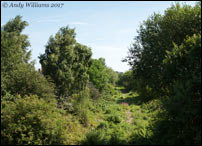 July 2017: Taken from near enough the exact same spot as the 2004 shot. As in so many places uncontrolled vegetation had
eliminated any sort of view. Dudley town centre, one of the highest locations in the Black Country, was no longer visible, resulting in a "could
be anywhere" photo. You can at least still see the path of the trackbed, still trackless here of course.
July 2017: Taken from near enough the exact same spot as the 2004 shot. As in so many places uncontrolled vegetation had
eliminated any sort of view. Dudley town centre, one of the highest locations in the Black Country, was no longer visible, resulting in a "could
be anywhere" photo. You can at least still see the path of the trackbed, still trackless here of course.
Pedmore Road (Dudley), looking south
-
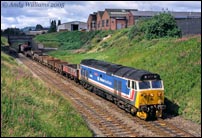
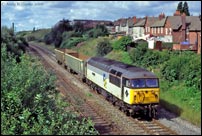 July 1992: 56044 heads away from Round Oak at 10:12 on Tuesday 28th July 1992. The train is 6M12 Cardiff - Bescot, which would
almost certainly have dropped steel wire at Brierley Hill. The two wagons still attached are empty scrap carriers, probably bound for the scrapyard
at Moxley.
July 1992: 56044 heads away from Round Oak at 10:12 on Tuesday 28th July 1992. The train is 6M12 Cardiff - Bescot, which would
almost certainly have dropped steel wire at Brierley Hill. The two wagons still attached are empty scrap carriers, probably bound for the scrapyard
at Moxley.
-
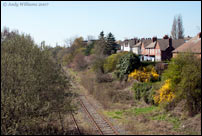 April 2004: This shot was taken from a much narrower angle due to the inevitable increase in vegetation. This is the
southern limit of the closed section of line. At this time the northbound (down) track was still available as a headshunt for Round Oak steel trains,
terminating in a set of buffers just out of sight under the bridge. The track was shiny to within a hundred yards of the bridge.
April 2004: This shot was taken from a much narrower angle due to the inevitable increase in vegetation. This is the
southern limit of the closed section of line. At this time the northbound (down) track was still available as a headshunt for Round Oak steel trains,
terminating in a set of buffers just out of sight under the bridge. The track was shiny to within a hundred yards of the bridge.
-
July 2017: No shot available due to further tree growth on the left (upside). The headshunt and stop-block were still extant,
although none of the visible track was shiny on my visit.