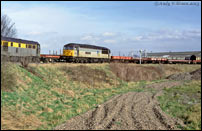
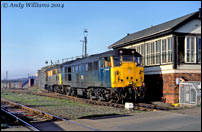
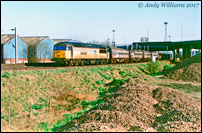
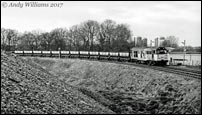
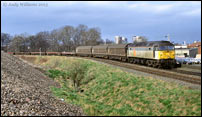
Wednesbury 1993
The freight line between Bescot/Pleck Jct and Round Oak was closed with effect from Monday 22nd March 1993, and the last trains ran on Friday 19th March. When the end came there were still three sources of traffic on the line between Bescot and Stourbridge. The steel terminal at Wednesbury had closed in late 1992, but the spoil tip was still in use right to the end. The site was subsequently used for the Midland Metro tram depot and railway spoil traffic from Bescot was re-directed to the tip at Honeybourne.
The second source of traffic was the steel terminal at Round Oak. This was operated by Round Oak Rail, a private firm. Traffic here consisted of steel, mainly in the form of coil, mostly manufactured at Llanwern (Newport) and Port Talbot (Margam) in South Wales. Round Oak remains open to this day, and is very busy with paths for three incoming trains a day. All trains must now reach Round Oak from the south, but as all the vast bulk of the current traffic comes from South Wales this isn't much of a problem.
The third traffic source was Brierley Hill, a steel terminal operated by British Rail itself. It also handled steel, but mainly in the form of wire and rod. In 1993 most of Brierley Hill's traffic emanated from the Allied Steel & Wire (ASW) plant in Cardiff docks, although traffic from other sources (including imports) was routed through Bescot. In recent years Brierley Hill has led a chequered existence, being closed and re-opened on a couple of occasions. It was operated by EWS in the post-privatisation years. For a year or so in 2004/05 it was being used for roadstone from Peak Forest (near Buxton), in addition to steel from Scunthorpe which was the staple traffic. However the stone trains ceased early in 2005, and in September 2006 Brierley Hill closed yet again - the Scunthorpe traffic having been diverted to Wolverhampton. That wasn't the end though, in the second half of 2007 stone trains started running from Croft Quarry (in Leicestershire) to Brierley Hill, and although they run sporadically these trains were still operating in 2011. There were also a few outgoing scrap trains to Southampton and Cardiff in the mid 2000s, but these never developed into a regular flow.
Other traffic referred to in the table below includes 6E58, another steel service originating from the ASW plant at Cardiff. During the final months this was the only train booked to take the direct Wednesbury - Walsall route rather than go into Bescot. Another regular train in 1993 was the china-clay service from St Blazey (near Par) in Cornwall to Cliffe Vale in Stoke-on-Trent. This was a long-standing railfreight flow which had no special reason to use the freight line through Wednesbury, other than the fact that it was the traditional and most convenient route. When the line closed it was simply re-routed to run via Bromsgrove, the Camp Hill line (through Birmingham but avoiding New St), Washwood Heath, Sutton Park and Walsall.
In its final years the line was busiest during the morning, and even at the end there was a reasonable amount of traffic early in the day. Afternoons were normally quieter. As in 1989 the signal boxes were still open Monday to Friday on a two-shift pattern, but although the line was nominally open until about 21:00 the loss of the evening Speedlinks meant that the man on the afternoon turn could often get away early. As can be seen from the table 6V70 was usually the last train of the day in 1993.
It should be evident from the movements recorded below that trains from the south were unable to get into the sidings at Round Oak due to problems with the signalling and trackwork there. Consequently these trains were routed into Bescot where the locomotive would run-round the train and head back south to Round Oak. This arrangement inflated the number of trains through Dudley and Wednesbury. Look out too for the problems involved in getting the final spoil train out of Wednesbury on Friday 19th. This also increased the number of movements that took place on that last Friday.
The tables below list all the movements through Wednesbury during the final week of normal service. Where the loco is shown in grey this indicates that this is the engine that should have worked the service according to the diagrams - but I wasn't able to confirm it. For the uninitiated the four-character train codes such as "6M11" are used to identify particular services. The first character identifies the type of train, the second character the destination (usually defined in very broad geographical terms) and the last two numbers are an arbitrary value to identify a particular service. The significant thing to note here is that codes starting with "0" such as 0T46 are locomotives without a train in tow - "light engines" in railway parlance. On the line through Wednesbury "up" trains ran southbound (towards Stourbridge) and "down" trains ran northbound (towards Bescot and Walsall).
| Trains through Wednesbury on Monday 15th March 1993 | |||
|---|---|---|---|
| Train | Wednesbury | Loco | Comments |
| 6E58 Cardiff - Wakefield | 06.02 | 56064 | |
| 6M11 Margam - Bescot | 06.17 | 56038 | |
| 6T46 Bescot - Round Oak | 07.26 | 56038 | |
| 0T46 Round Oak - Bescot | 08.09 | 56038 | |
| 6T50 Bescot - Brierley Hill | 08.34 | 47310 | |
| 6V05 Bescot - Llanwern | 10.26 | 56038 | Probably dropping traffic from Bescot at Round Oak and collecting empties there. |
| 0M12 Cardiff - Bescot | 10.40 | 56040 | Traffic deposited at Brierley Hill on way north. |
| 7Z09 | 12.25 | Tamper | Down direction. |
| 6T50 Brierley Hill - Bescot | 12.42 | 47310 | |
| 6V69 Bescot - Cardiff | 13.28 | 56040 | |
| 0X00 | 16.22 | 08xxx | Up direction. Believed to be a shunt-engine turning move from Bescot via Wednesbury and Pleck Jct. |
| 0X00 | 16.23 | 08xxx | Down direction. |
| 6V70 Cliffe Vale - St Blazey | 18.48 | 47200 | |
| Trains through Wednesbury on Tuesday 16th March 1993 | |||
|---|---|---|---|
| Train | Wednesbury | Loco | Comments |
| Neither 6E58 nor 6V69 ran on this day. | |||
| 6M11 Margam - Bescot | 07.31 | 56038 | |
| 6M72 St Blazey - Cliffe Vale | 07.48 | 47200 | |
| 6T46 Bescot - Round Oak | 09.07 | 56038 | |
| 6T50 Bescot - Brierley Hill | 09.48 | 47330 | |
| 6T46 Brierley Hill - Bescot | 10.26 | 56038 | Probably with traffic from Round Oak. |
| 0M12 Cardiff - Bescot | 10.54 | 56040 | Traffic deposited at Brierley Hill on way north. |
| 0V05 Bescot - Round Oak | 11.37 | 56038 | For 6V05 Round Oak - Llanwern. |
| 6Z67 (South Wales) - Bescot | 13.00 | Additional steel train, probably ex-Llanwern or Margam, bound for Round Oak. | |
| 6T50 Brierley Hill - Bescot | 13.24 | 47330 | |
| 6Z67 Bescot - Round Oak | 14.37 | ||
| 0Z67 Round Oak - Bescot | 15.30 | ||
| 0Z67 Bescot - Round Oak | 16.33 | Presumably for the empties out of Round Oak back to South Wales. | |
| 6V70 Cliffe Vale - St Blazey | 18.07 | 47200 | |
| Trains through Wednesbury on Thursday 18th March 1993 | |||
|---|---|---|---|
| Train | Wednesbury | Loco | Comments |
| No 6V69 on this day. | |||
| 6E58 Cardiff - Wakefield | 05.55 | 56064 | |
| 6M11 Margam - Bescot | 06.25 | 56053 | Carried a headboard. |
| 0T84 Bescot - Wednesbury | 07.59 | 31407+31512 | |
| 0F80 Bescot - South Wales | 08.06 | 56053 | Loco had failed and was returning to the Western Region under its own power. |
| 6M72 St Blazey - Cliffe Vale | 08.34 | 47200 | |
| 8T84 Wednesbury - Bescot | 09.17 | 31512+31407 | Penultimate rake of empties from the CCE tip. |
| 6T46 Bescot - Round Oak | 09.37 | 56060 | Fresh loco provided to replace 56053. |
| 0T46 Round Oak - Lawley St (?) | 10.33 | 56060 | |
| 6T50 Bescot - Brierley Hill | 10.35 | 47344 | Running a bit late. |
| 0M12 Cardiff - Bescot | 11.21 | Traffic deposited at Brierley Hill on way north. | |
| 6T46 Lawley St (?) - Round Oak | 12.04 | 56060 | Details for this are a bit sketchy but it was believed to be a train of steel on container flats originating at Hull and sent to Lawley St in error. Assuming it did originate at Lawley St it would have been the last train to traverse the Pleck Jct - Bescot Curve Jct section of track heading south. |
| 6T44 Bescot - Round Oak/Brierley Hill | 13.00 | 37884 | |
| 6T50 Brierley Hill - Bescot | 14.03 | 47344 | |
| 0T44 Brierley Hill - Bescot | 14.25 | 37884 | |
| 0Z26 Bescot - Round Oak | 17.26 | For the empty flats, which appear to have gone south from Round Oak. | |
| 6V70 Cliffe Vale - St Blazey | 17.46 | 47304 | |
In fact there were one or two other movements on the line after it had formally closed. A cable-laying train traversed at least part of the route later in 1993, with Class 31s in charge. Over subsequent years the line began to fall into increasing disrepair. Vegetation slowly began to take over, with mature trees eventually growing on the trackbed. For the first couple of years after closure there was evidence of vegetation clearance on the southbound track, but by the time Railtrack took control all signs of maintenance disappeared. The signalling equipment was removed shortly after closure, and the signal boxes at Wednesbury and Eagle Crossing (Great Bridge) were both subsequently destroyed by fire.
Developments after closure
Since the line closed four civil engineering projects have required the construction of new bridges, three of which cross over the railway line and one which goes under it.
- The first new bridge was needed for the construction of the Black Country Spine Road between Wednesbury and Great Bridge. The Spine Road opened in 1994 and a dual-carriageway now crosses the line just a few yards south of Eagle Lane via a four-span viaduct. The extensive road works associated with this project saw Eagle Lane itself closed as a through-route to road traffic - it's now a footpath.
- The second project was the opening of the Midland Metro in 1999. This required a new bridge to carry the ex-GWR alignment - now the Metro route - over the South Staffs line at Wednesbury. The original bridge which carried the GWR railway line at the same location had long since gone by the time that the Metro was built.
- Later in 1999 a new road bridge was built at Cinder Bank to take the Dudley Southern Bypass over the railway. The railway alignment was carefully preserved, but the track was removed in the vicinity of these works, and not replaced of course.
- The most recent bridge work occurred at the northern end of the closed section. This involved a new development on the land to the east
and west side of the South Staffs alignment, just south of where it crosses the Grand Junction line and goes underneath the M6 motorway.
This was land previously used by Wood Green High School, Bescot Drop Forgings, and the Spear & Jackson factory (previously Elwells).
The latter pair of factories stood on the east (Bescot) side of the South Staffs alignment, and were accessed from St Paul's Road, Wednesbury. This road isn't suitable for modern lorries, partly because it bisects the High School campus. So a new access road will be needed to link any developments on the east side of the South Staffs alignment directly to Junction 9 of the M6.
This new road needs to pass underneath the abandoned railway, and thus a new bridge was built immediately alongside the existing Wood Green viaduct in 2007. The new bridge butts up against the northern end of the viaduct, and will carry the railway alignment over the new road, if and when the road is ever built. Four years after the bridge was built, in summer 2011, there had still been no construction on the east side of the railway line, meaning that the road wasn't needed. I believe that planning permission exists for a hotel on the land where the Drop Forgings once stood, but the recession seems to have put the mockers on this.
Re-opening?
Almost as soon as the line closed there was talk of re-opening in the air. For many years a Midland Metro route from Wednesbury to the shopping centre at Merry Hill (via Dudley) had been planned. This would use, or at least share, the South Staffs trackbed for much of its route. When this page was last revised in summer 2011 those plans were nearly 20 years old, but beyond some surveying, no work had started, and no firm plans were in place. Various dates had been mooted, but with funding not secured these were always aspirational rather than definitive.
By summer 2008 the Centro website had quietly introduced the possibility of running tram-trains on the Wednesbury - Brierley Hill route, but the most significant development in recent years has been the apparent loss of interest in this route - originally described as line 2 - in favour of extending the Metro around Birmingham City Centre. Useful as it might be, extending the Metro around the City Centre looks like putting the cherry on a cake when you've only baked one slice.
Railfreight had been in slow decline for many years, but there was a brief period of growth and optimism towards the end of the 1990s following the takeover of most British railfreight operations by EWS (English, Welsh and Scottish Railway). This led to talk of re-opening the line for freight, in large part as a way of bypassing the congested tracks around Birmingham for freight trains running on the south-west/north-east axis. This would make much more sense if it was to occur in conjunction with the re-opening of the Walsall - Lichfield line, which closed as a through route in 1984. However this is another aspiration which isn't going to happen for some years, if ever. In early 2005 the Strategic Rail Authority released a document entitled West Midlands Route Utilisation Strategy (bottom of page 55). This document briefly mentions the line and concludes thus: "The Route Utilisation Strategy does not propose to promote the reinstatement of the Round Oak - Bescot route but confirms the need for the route to be protected for the longer term".
Despite all the talk it's clear that nothing is going to happen anytime soon. Eighteen years after closure the trees continue to grow unchecked, and for the majority of that period the amount of traffic and congestion on the local roads continued to rise inexorably. Only in recent years has this trend shown any signs of stalling, with the steep rise in petrol prices combined with the recession. Sadly the Metro system is in no position to be of any great use to motorists looking for public transport alternatives - most of it still not having been built.
See the Pleck Jct - Round Oak page for more pictures of how the line looked in the late 1980s and early 1990s, compared with how it looked around 2004.