| 6M39 |
06.20 |
37183 |
This is the Cardiff Tidal - Soho Pool oil train. Soho Pool was in the Winson Green area of Birmingham, and by this time was reached
via a spur from the Perry Barr - Soho Jct line.
Other entries in the register reveal that this was a solid diagram for a Landore Class 37. Class 31 and 37 locos were much less common
in the Black Country in 1976 than they would be in later years. At this time Classes 25, 45, 46 and 47 still dominated the local
freight scene. If 31s or 37s appeared they were usually intruders from the Eastern or Western Regions working out-and-back diagrams.
They'd generally head straight back home with the same crew.
This train was booked for a Hymek, and got one, until 1972. |
| 8T29 |
06.28 |
47554 |
The trip notice shows T29 leaving Bescot at 05:55, bound for Brierley Hill. It was also booked a Class 25,
like many of the local trip workings at this time. It was relatively unusual to find a loco fitted with electric train heat out on a
freight at this time, but 47554 was a local engine, being allocated to Bescot. |
| 6V53 |
06.46 |
D1071 |
A Western on the china-clay. I've shown it as D1071 because that's how the signalman noted it, although by this time it was plain
1071 officially. 6V53 was the Stoke - St Blazey clay empties, and for a period in the 1970s it was booked for a Western as many people will
remember. What's unusual here is that this is a very late appearance, probably one of the last half-dozen or so on this train. On this
date there were only 21 Westerns left in traffic (the full set of withdrawal dates can be found
here). Three more were withdrawn in October, seven
in November, four in December, two in January, and the final five went at the end of February 1977. 1071 was one of the December
casualties.
To put this working into context 6V53 was a no-show on Wednesday 29th, it was 47026 on Thursday 30th, and 46006 on Friday 1st October.
Clearly Westerns were no longer turning up regularly, and probably hadn't been so for some time. However a 1970s railway photo book
includes a shot of 6V53 at Bristol on Monday 4th October. 1065 was in charge that day, so Westerns were still appearing occasionally
in autumn '76.
The signalman who noted the loco numbers was next on mornings during the week commencing Monday 18th October. That week 6V53
was a no-show on Monday 18th, it was 46006 on Tuesday 19th, 1015 on Wednesday 20th, 46006 again on Thursday 21st, and 1013 on Friday
22nd. Two different Westerns that week, something that's unlikely to have happened again.
The week starting Monday 8th November produced 46003, 46017, 46025, 47090 and 45026. No Westerns to be seen at all - no great surprise.
6V53 was a no-show on Monday 29th November, and then produced 47493, 47146, 47493 and 47441 for the remainder of the week. Quite an
unusual run of 47s for this train, but once again no Westerns.
The week commencing Monday 20th December produced 46012, no-show on the Tuesday (the up line was blocked at Eagle Crossing due to
flooding, so it was probably diverted via Soho), 47190, 46002 and then nothing on Friday 23rd when it probably didn't run at
all due to the Christmas holiday.
The last week in this register started on Monday 10th January 1977. Our man was on mornings that week, and 6V53 produced 46016, 47061,
46016, 47061 for Monday to Thursday. Interestingly the register shows an 8Z53 on Friday 14th, and as the loco was 46016 we can safely
assume this was a re-coded 6V53. There's a clear two-day cycle in the loco diagrams at this point, but unsurprisingly no sign of a
Western.
Photo of D1049 Western Monarch leaving Bescot on 6V53. Date unknown, but probably
1975 or early 1976. The Western swapped trains with an electric locomotive at Bescot, and the northbound service was coded 6M55.
|
| 0M83 |
07.04 |
46018 |
This is the loco off 6M83 Llandeilo Jct - Great Bridge, a block steel train. No doubt the loco is heading for Bescot. |
| 0T20 |
07.12 |
25272 |
A minor puzzle here. This is the first entry for either T20 or 25272 on Tuesday 28th, and it actually says "Exchange to Up
Sdgs". T20 started at Wolverhampton Holding Sidings, but the trip notice shows it running light to
Bescot via Portobello, and then working traffic to Wolverhampton Steel Terminal via Priestfield. It should have been at Wednesbury from
07:05-07:25 on this leg. In the event it looks like it's run from Wolverhampton to Wednesbury via Priestfield, ending up at
Wednesbury at roughly the right time. It next appears in the Wednesbury register at 09:32, and my guess is that it did a round
trip to Wolverhampton Steel Terminal via Priestfield as this is what it was booked to do between 07:25 and 08:45. |
| 8T30 |
07.40 |
20139+20004 |
These 20s were heading to Wolverhampton New Depot via Princes End. The signalman noted the destination in the register as "WTN
N DPT". New Depot is another name for what's now called Wolverhampton Steel Terminal. It's interesting to note that in this
register the three regular signalmen each described it in a different way. One used "Wtn New Depot" or more often a diminutive
form such as "Wtn N Dpt"; the second man preferred the minimalist "ND"; and the third bloke used "Wton S T"
or some variation thereof.
The trip notice shows T30 booked for a pair of 20s, but suggests that during the morning it should be
working coal traffic. Not on this day by the look of it. |
| 8M77 |
07.54 |
46039 |
This was a mixed freight from Severn Tunnel Jct to Bescot. The loco would return south on a similar working
a couple of hours later, which makes it a prime candidate to be an out-and-back working for a Gloucester traincrew.
Interestingly 8M77 was booked to stop and detach traffic at Brierley Hill on the way past. Not what you'd really expect in the 1970s. It
would be more usual for such traffic to get tripped back from Bescot, especially with the number of trip workings available at the time. |
| 8G87 |
07.58 |
45044 |
A Wellingborough - Spring Vale iron ore train, routed via Princes End. Another one where the signalman noted the destination in the
register. This train could also run to Croes Newydd (Wrexham) if required, in which case the headcode would be 8J87 and the destination
would be Brymbo steelworks. |
| 0T37 |
08.24 |
25281 |
This loco arrived off the Princes End branch. This entry contains the remark "Van propelled to Exchange". Evidently
the loco had arrived with a brake-van in tow, and propelled it into the Exchange Sidings. T37 was an
engineer's trip based at Wolverhampton, and may have come from there to start its
day's work. |
| 8T37 |
08.53 |
25281 |
The same loco works forward with a train from Wednesbury Exchange Sidings, maybe to Bescot. |
| 8T26 |
08.59 |
47531 |
A trip freight to Wednesbury Exchange Sidings, no doubt from Bescot. And a second Bescot-allocated 47/4 working a trip booked for
a Class 25. The trip notice shows two Bescot - Spring Vale workings in the morning, but on this day it
looks like the first of them ran to Wednesbury instead. |
| 6V80 |
09.12-09.15 |
37183 |
The Landore 37 heads home on the Soho Pool - Cardiff empties. It wasn't immediately obvious why this train was checked at Wednesbury,
but closer inspection of the register reveals a "blocking-back" indication (bell code 2-4) sent from Eagle Crossing at 08.53.
The corresponding train-out-of-section wasn't received until 09.14. It would therefore seem that there was some shunting going on at
Great Bridge which meant that 6V80 had to be checked at Wednesbury.
Other entries in the register show that both 6M39 and the balancing 6V80 were running a bit late on this day. Perhaps 1-1½
hours late by the look of it. |
| 8Z36 |
09.24 |
46033 |
Another train bound for Spring Vale via Princes End. The "Z" headcode indicates a special working. |
| 0T20 |
09.32 |
25272 |
After returning (I think) from Wolverhampton Steel Terminal T20 departs light engine, almost certainly to Bescot. The
trip notice suggests it should have departed at 09:35, so it's remarkably close to time. |
| 0T26 |
09.44 |
47531 |
45 minutes after arriving 47531 heads back north light engine. Once again Bescot is the most likely destination. |
| 6F05 |
09.51 |
45044 |
The Peak returns on the iron ore empties. |
| 8T29 |
10.04-10.22 |
47554 |
On its return north 47554 stopped at Wednesbury to attach traffic in the Exchange Sidings. The trip notice
had it booked to pass Wednesbury on its way back to Bescot at 10:00. |
| 8V61 |
10.24 |
46039 |
This is a mixed freight from Bescot to Severn Tunnel Jct. Although the destination wasn't noted against this entry, it does appear
on other days.
Other entries in the register reveal that this train occasionally ran as a Class 7 (as did the other mixed freights bound for
the WR). It usually appeared at Wednesbury in the two-hour window between 10.30-12.30, but could be even earlier or later than that.
Nowadays freight trains tend to run closer to their booked time, unless there's been a problem. |
| 0T58 |
10.38 |
24057 |
Light-engine from the Dudley direction, no doubt heading to Bescot. The trip notice suggests this should
have been a Kidderminster - Bescot train, with stops at all shacks bar Wednesbury. But there was no traffic on this day it would seem. T58
was based at Stourbridge, which explains why its first appearance of the day is from the south, and its last appearance takes it back south.
Class 24s were once quite common at Wednesbury, but by this date there were only about 10 or 11 of them still left in traffic. Despite
that they still appeared regularly in the Bescot area. 24057 was back at Wednesbury on Thursday 30th (T37), and also on Friday 30th
(T25). Later entries show 24047 on Monday 4th October (T69). 24057 again on Wednesday 6th October (T69). 24047 turned up again on the
evening of Friday 8th October (T58), and 24057 again in the early hours of Saturday 9th (T27).
24047 was reluctant to disappear, and appeared again on Wednesday 13th October (T58). However a new one in the form of 24087 showed up
the next day on T20. Incredibly Friday 15th October produced no fewer than three separate Class 24s at Wednesbury, and all in the
afternoon shift. 24087 was on T20, 24081 was on T69, and 24133 was on T32. There are plenty of similar workings later in the register. |
| 8M65 |
10.40-10.55 |
37114 |
The second 37 of the day. 8M65 was a Tyne Yard - Brierley Hill train, and conveyed a mixed load rather than being the block steel train
I originally imagined it to be. The train was booked to stop at Wednesbury to detach traffic, and that's exactly what it did on this
occasion when wagons were left in the Up Sidings. In fact it wasn't unusual for this train to terminate at Wednesbury.
This train was regularly hauled by a 37, although not always from a north-east depot. 37114 was a March engine at this time, as was
37037 which worked 8M65 on Wednesday 20th October. However Friday 22nd produced 37090 (Healey Mills or Thornaby), and Tuesday 9th
November 37216 (Gateshead). Look hard enough and you'll always find an aberration, and so it was on Friday 12th November when
31293+31276 arrived at Wednesbury with 8M65.
The best find for this train was Wednesday 3rd November. We've no loco details because the wrong signalman was on mornings that week,
but the Up line entry for 8M65 shows that it arrived Wednesbury's home signal at 11.05. It appears that the train was due to terminate
at Wednesbury. However there's an entry in the Down line table which shows the bell code 6 (Obstruction Danger) and the comment
"Sent to Eagle Xing at 1135. 8M65 derailed in Sdgs. Rear portion of train foul of Main Line. W'bury GF restored and working
correctly at 1135. No 22B points disconnected and clipped to release lever 22. Wbury GF released 1200 restored 1210."
The corresponding 2-1 (Obstruction Removed) was sent to Eagle Crossing at 12.10.
There's an 0Z98 light-engine shown as arriving from Great Bridge at 10.58, and departing north at 11.28. My guess is therefore that
8M65 was allowed into Wednesbury after this loco had passed, as the times would fit. Evidently while running into the sidings 8M65
has come off the road with the back-end still fouling at least the Down line. The next movement was 8T30 which arrived Wednesbury at
11.30, and was allowed up the Princes End branch at 11.55. It was hotly pursued by 8T20 which passed Wednesbury at 12.05, having been
queued behind T30. All was certainly back to normal within the hour as 6V06 went south towards Great Bridge at 12.10 and 6M81 came
north on the main line at 12.28. It's hard not to wonder how long an episode like this may have taken to sort out on the 21st century
railway. |
| 8T26 |
11.03 |
47531 |
47531 does its second trip of the day, this time bound for Spring Vale via Princes End. The booked working was 09:50 off Bescot, so
it's an hour late on that timing. |
| 8T20 |
11.12 |
25262+25272 |
Having departed at 09.32 25272 re-appears an hour and a half later paired up with 25262. Having attached another engine it can only
have been to Bescot of course, perhaps that the return load warranted extra power? Impossible to know at this remove.
The route for this train says "To Exchange", and there are no times in the "Advance Section" columns so the train
wasn't offered to another box. On first glance this implies that the train terminated at Wednesbury, but it didn't. The destination is
shown as "Woln N Dep", indicating that the train was bound for Wolverhampton New Depot via Priestfield. This is consistent
with the trip notice, which has it at Wednesbury from 10:35 to 10:55.
They should have been back at Wednesbury at 12:00, before heading off light back to Wolverhampton Holding Sidings for the end of the
morning shift, but they didn't return in this slot, so perhaps there was no traffic. |
| 0M65 |
11.19 |
37114 |
This loco returned north incredibly quickly. As it had only been away for 24 minutes it could have gone no further south than Great
Bridge. It would almost certainly have been a foreign crew, and it looks as if they were keen to get home. |
| 8T25 |
11.27 |
45055 |
Another Peak off the Princes End branch, and another Type 4 on a trip booked for a Type 2. The trip notice
suggests it should have been en-route from Wednesfield Road via Wolverhampton station, conveying traffic to and from Bloomfield Wagon
Works en route. The destination would have been Bescot. |
| 9X21 |
11.36 |
25263 |
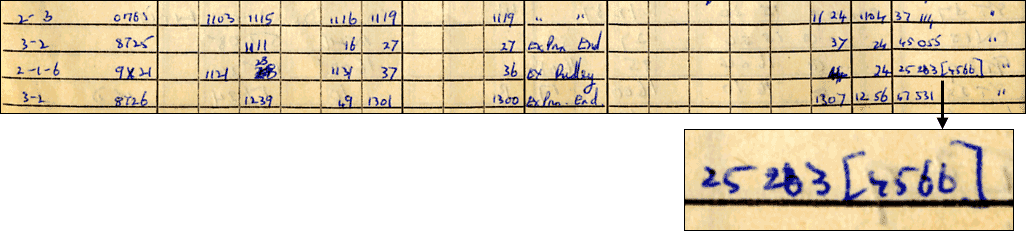
A puzzle this. It was a northbound train, and the "9X" code signifies some sort of special load, as does the 2-1-6 bell
code. However it was only when I transcribed this entry that I noticed the contents of the remarks column. Like all the entries made
by this signalman the writing is small and sometimes a little unclear, but what it appears to say is: 25263 [4566]. Judge for yourself
by looking at a scan of this entry. As you can see the "4" is ambiguous - it could be a
"7", but looking at his other 7s I doubt it.
On reflection I'm sure that it's a "4" and I strongly suspect that the load was steam
loco 4566, a 2-6-2 "Small Prairie" tank loco based on the Severn Valley Railway. Evidently 4566 was recovered from Barry
scrapyard in 1970, and first steamed again at the SVR in 1975. It seems conceivable that it was temporarily moved in 1976 for some
reason, and 9X21 could easily have originated at Bewdley or Kidderminster.
A few days later, at 15.12 on the afternoon of Friday 1st October, a 9X40 special passed Wednesbury heading south. The signalman noted
"BRIDGE NORTH" (sic) in the register. Despite the spelling there's no doubt that this is a reference to Bridgnorth. Could it
have been 4566 returning home? Maybe, although it would only have been away for three days, which is pretty quick if it was moved
for some sort of maintenance work.
Postscript: Information kindly provided by Ian Pell confirms my surmise that steam loco 4566 was indeed conveyed in this
train, which was seen heading south past Saltley and reported in a contemporary magazine (Mid Rail, Volume 1, Number 10, Nov 1976).
It was probably en-route to Tyseley for tyre-turning. |
| 8M12 |
12.02-12.30 |
31211 |
This is a Scunthorpe - Wolverhampton steel train, routed via Princes End. Traffic was detached in the Exchange Sidings during the
Wednesbury stop. According to my 1976 Shedbook 31211 was transferred from March to Immingham sometime during 1976 or early 1977, and
I'd guess it was probably an Immingham loco by this time given the origin of the train. |
| 8T58 |
12.28 |
24057 |
24057 ran north, light-engine, at 10.38, and it now returns south with a train two hours later. It would have been to Bescot, as per the
trip notice, but is an hour or so late heading south. Further entries in the register show 8T58 arriving again
from the south at 16.14, and pausing at Wednesbury until 16.47 on its second visit to Bescot. Later still there was an 0T58 which arrived
from Bescot at 18.37, and departed south as 6T58 at 18.54. Apart from running late it was pretty much doing the scheduled moves.
T58 was always a Derby-built Type 2 during late 1976, and 24057 wasn't the only 24 which appeared. Amongst the other locos recorded
were: 25143 on Friday 1st October; 24047 on Friday 8th October; 25253 on Tuesday 12th October; 24047 again on Wednesday 13th October;
25294 on Friday 15th October; and 25143 again on Monday 18th October. |
| 8V82 |
12.55 |
45055 |
This loco had worked north off the Princes End branch at 11.27, and 90 minutes later it now heads south on a train bound for the
Western Region. Evidently the Type 4 has been replaced on the T25 diagram.
8V82 was a Bescot - Gloucester mixed freight. It's only two and a half hours behind the Severn Tunnel bound 8V61, but in this
era there were three or four mixed freights each day on the principal routes such as Bescot - Gloucester and Bescot - Toton. 8V82
normally appeared at Wednesbury between 13.00 and 15.00, so like 8V61 it was a bit early on this day.
If 8V61 ran late and 8V82 ran early they could end up pretty close together. In fact that happened the very next day, Wednesday 29th
September. On the 29th a late-running 8V61 passed Wednesbury at 12.47 behind the very rateable 37188 (Landore). 8V82 was only
half-an-hour behind, and passed at 13.19 behind 47043. Even 47043 isn't as mundane as it first appears, it was an Immingham
loco in 1976.
Further research reveals that 37188 had come north on Wednesday 29th via 6M39, which was in fact 47367+37188. 6M39 was quite a bit
late (07.06 through Wednesbury) so it could be that the 37 had failed. If it had then it had been fixed fairly promptly. Anyway it was
packed off back to the WR sharpish via 8V61, and 47452 was provided for 6V80 which passed Wednesbury well late at 10.33. |
| 8T26 |
13.00 |
47531 |
Returning from Spring Vale via Princes End, and no doubt bound for Bescot. |
| 6T30 |
13.54 |
|
This last train is another minor puzzle, last seen heading towards Wolverhampton at 07:40, it now appears from the Bescot direction.
We have no loco number because it was accepted at 13:44 by the morning shift signalman, but his relief had taken over by the time the
train arrived at 13:54. This train is heading south towards Dudley, and the trip notice suggests it would
have been working empties from Heath Town to Round Oak, via Portobello Jct and a run-round at Pleck Jct. |